Showing posts with label writing. Show all posts

14 August 2022

The awkward geometry of a warming oblate spheroid

The latest poetry pamphlet from The Text Biz is available now.

The awkward geometry of a warming oblate spheroid is about climate change. The oblate spheroid is, of course, the Planet Earth. The movement through the various forms in this sequence of poems can be interpreted to echo the disruption caused by catastrophic climate events, as the shape changes from the formal and lyrical, to free verse, concrete poetry, and ultimately a parody of all that has been lost.

Get some words and ideas for a climate protest or a climate rally!

4 February 2021

Poetry by Bruce Marsland

Maybe every individual enterprise includes something a little more individual than enterprise.  

The meat, potatoes, and apple pie of The Text Biz are the editing, educational, and consultation services.  The digestif is the creative writing, and particularly the poetry.

So now is the time to give that after-dinner part of the business the breathing space of its own web portal: poems, publications, and links to texts published elsewhere, as well as a little biographical background.

For the manually inclined, just type brucemarsland.com into that bar at the top of your screen, and press enter.

For the mousers, click the image.  You know the drill.


17 October 2020

No like like like


Poetry by this author:
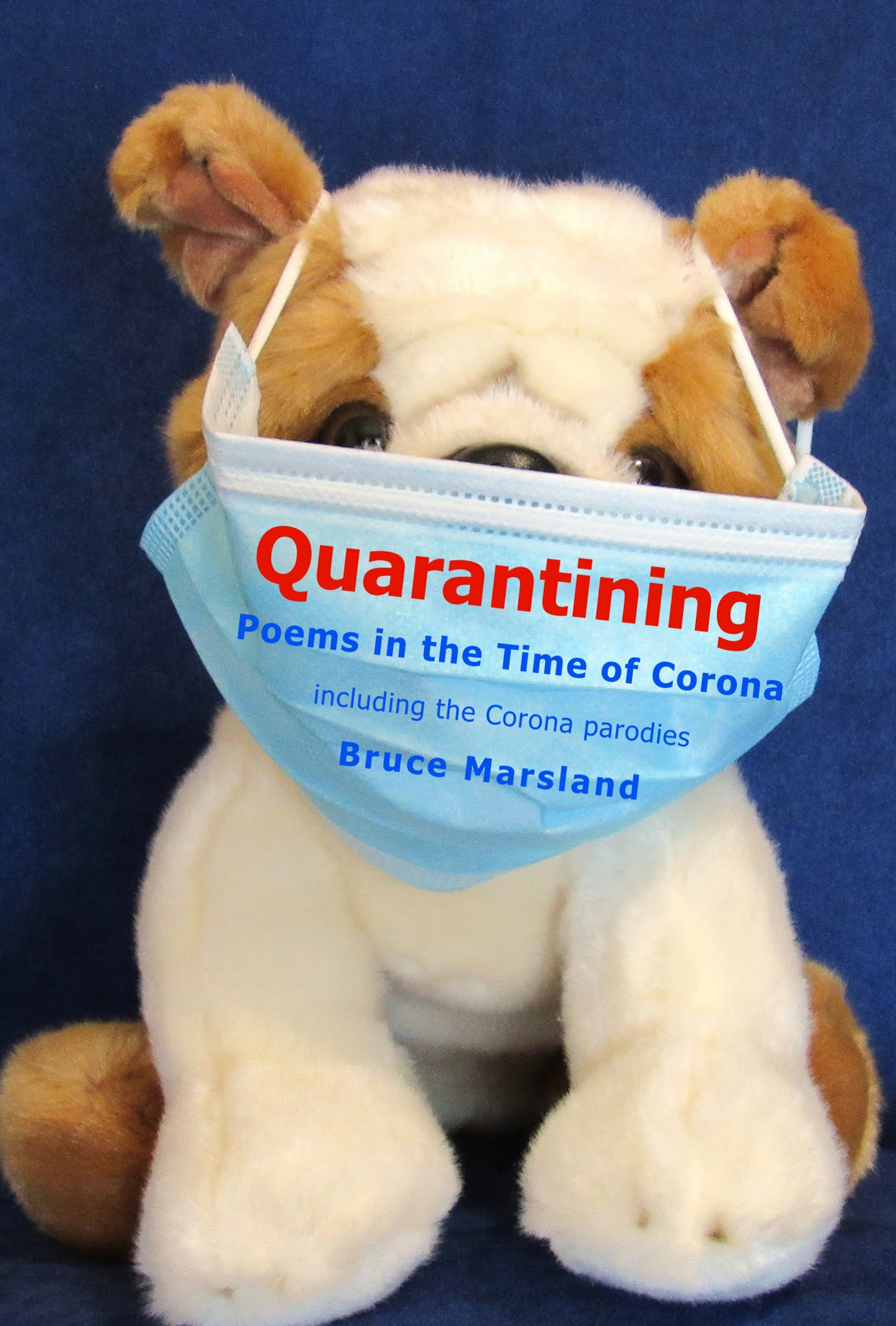
Quarantining: poems in the time of Corona
Magnetic Resonance Imaging: lyrics of love and loss
Those Footsteps Behind: around the world in 50 poems

29 July 2020

Interview with a writer

... and that writer is me.

I am thrilled to have been highlighted as the Monday Writer in Sentinel Literary Quarterly for 27 July 2020.


28 July 2020

Poetry from the text biz

Check out the updated list of poetry publications.


In 2020, a modern plague swept across the world. Covid-19, also known by its generic term Coronavirus, brought major disruption to every continent on the planet. As Covid-19 raged, stretching medical services and sending whole countries into lockdown, writers and artists were among those who rallied with a burst of shared endeavour. The poetry in this collection, by Bruce Marsland, is an example of such a response. Consisting of original poems alongside parodies of famous works, Quarantining: Poems in the Time of Corona represents a slice of life in troubled times.


The 50 poems in this collection are inspired by different travel destinations around the world. From Hawaii to New Zealand, and from Finland to South Africa, this collection moves through many of the compass points on a traveller’s atlas. While the main theme is travel, the notion of time is also a constant presence. The poems echo a traveller’s footsteps over a period of some three decades, but also the footsteps of others, through history and the present day, with one eye on the future.


'Magnetic resonance imaging' explores the psychological themes of love, growth, and loss through lyricism and poetry. The collection is loosely based on the structure of Vivaldi's 'Four Seasons'.


18 November 2011

Emphatically speaking

Linguists tend to be a pedantic lot. Faced with a good old bulleted list, the amount of time that goes into discussing the relative merits of introductory colons, initial capitals, and final full stops can be quite phenomenal.

It's a question of finding the right style.

Grammar is open to opinions as well, of course. One example might be whether the cricket correspondent should write 'England is all out' or 'England are all out' after the batting has collapsed yet again. The nature of style, though, means that it is always open to variation.

Faced with such choices, many people develop strong personal preferences and strong pet peeves in stylistic issues. One such issue is the use and misuse of emphasis.

There are several ways to emphasise a word or phrase, especially with software that can produce italicised and bold text at a single click. In some contexts, however, one form of emphasis might seem more appropriate than another.

Most web-savvy individuals realise that writing in all capitals is seen as the anti-social equivalent of shouting. Others realise that an underlined word on-screen may be misinterpreted as a clickable link. Italics, boldface, inverted commas, size, font, and maybe even colour can also all serve to highlight words for different effects.

One thing that does get a trifle irritating, though, is the use of multiple emphasis on one word. If a word needs that much emphasis, maybe the text is not doing the job in the first place.

9 November 2011

A menu of taste

One of the fundamental elements that we tend to use to judge countries and cultures is the food. Everybody eats, and travellers use restaurants frequently, often requesting a menu in English or in their own language.

Then, as a cuisine is exported, the concepts often need to be translated into the language of the new host nation, and maybe again for foreign visitors.

Our first experience of a cuisine, our first brush with a cultural flavour, is often therefore through the translated printed word.

Unfortunately, travellers' tales are frequently peppered with references to menus that are poorly worded or simply incorrect. The instinctive judgement of the food and the culture starts unfavourably.

Menus are certainly a specialist genre when it comes to creative writing, and creativity in a foreign language can be difficult. It is therefore no real reflection on the food if a restaurateur, probably trained to prepare gastronomic delight, sometimes falls short on linguistic subtlety in a non-native tongue.

There are sufficient complexities when writing a menu in your own mother tongue. Just now, opening a cookery book at random, I find that an English-speaking celebrity chef has come up with "poached skate with Thai flavours and its broth". Even recognising the difference between a menu and a recipe, this wording seems a little clumsy.

Many English speakers would also, I suspect, need to call the waiter over for help in understanding "trout saltimbocca". This doesn't mean that it's wrong, but, depending on the restaurant and the waiter, it might mean that fewer people choose it.

A menu needs to be worded so that it succinctly and attractively describes the contents of the dishes, implies the flavour of the food (with cultural references where appropriate), and reflects the overall theme of the restaurant.

That requires advanced linguistic skills as well as culinary prowess.

2 November 2011

Finding the funny bone

One of the hardest things to judge when reviewing a text for publication is the appropriate nature and quantity of any humour. It may be a fairly simple task in standard technical writing, where the clear expression of facts and instructions takes priority and humour tends to get in the way. In such cases, humour is almost automatically deleted.

However, there is a cline in the application of humour, culminating in a text that is explicitly and intentionally funny or satirical. When humour is included, any textual alteration needs to be very carefully considered in context. An apparently simple spelling 'mistake' may be a deliberate pun, even if the reviewer considers it to be a poor one.

Furthermore, there are questions of cultural appropriacy, including whether readers will find material offensive or maybe just won't have the background knowledge to get the joke.

In addition, the target group of a text may get a buzz from the delicate flavours of semantic sophistication or may prefer the rare-done red meat of outright mockery. Maybe only the writer knows which crowd is the real intended readership and how they like their comedy served.

In the middle reaches of the humour cline lie any number of text types, from press releases to theatre reviews to literary fiction. (And good luck, by the way, to those fine people embarking on NaNoWriMo, National Novel Writing Month, at this time.)

One of the challenges for a sensitive reviewer in all such cases is not to confuse linguistic correction with censorship of content. The chief editor at a newspaper may be entitled to wield the censor's pen over journalistic copy, but it does not follow that a proofreader has the same right to make such a call.

To make that distinction between language and content, a high degree of linguistic and cultural awareness is required. A lot of this awareness grows through writing. Editors who don't also write, edit at your peril!

26 October 2011

Towards the reading process

Whenever writers meet, either physically or virtually, it is probably inevitable that, at some point, talk will turn to "the writing process".

"The writing process" can mean different things to different people. For some, it may be almost mystical, as in the question frequently put to great writers of fiction, asking where they get their ideas from. For others, it may have an actual form, perhaps in the shape of an incomprehensible software manual, which often bears as much resemblance to a real writing process as a mobile phone user's guide does to a speaking process.

However, there is usually something missing. For how often does talk turn to "the reading process"?

It is the way in which a text is read that defines whether it is suitable, good, illuminating, or even genius. If a text cannot be read, then there is little point in writing it. And as the reader may not approach the text in the same way as the writer, the writer needs to write according to how the text is to be used, not according to how it is to be produced.

That's an easy thing to say, along with other great advice such as "know your reader". But it is the key to what works and what does not. Think "reading process", not "writing process".

This blog entry was first published at thetextbiz.com.

thetextbiz


Making writing extraordinary

Like a business, a piece of writing needs a unique selling point. The initial 'hook' gets the reader interested, and the subsequent material provides the meat and gravy.

Sometimes the unique selling point will come naturally from the subject matter. Sensational breaking news might have sufficient impact in itself to attract readers. However, in the vast majority of cases, language choices add to the pulling power of a text - or, in the worst cases, dilute its appeal.

Many principles of rhetoric have been devised around the idea of language 'sexing up' content. The terminology of marketing may be different, but the concept is essentially the same. Words sell.

When expressing a selling point, either the message needs to be unique, or the language needs to deliver the message uniquely, or - best of all - both of these should be true. In such a case, the 'hook' can be compelling.

Even in today's constant jostle for attention, with a unique pitch, just two words can be enough.

This blog entry was first published at thetextbiz.com.

thetextbiz